llm-relay-audit — An Agent Skill for Checking Relay APIs Before You Buy
llm-relay-audit is the audit procedure I use at work when choosing upstream suppliers for a platform, stripped of everything internal and open-sourced as an Agent skill. Give a relay’s base URL and key to an Agent such as Claude Code, Codex or Cursor; it compares the relay with the official API item by item following a fixed procedure, and hands you two reports: one you can send straight to the vendor, one for whoever makes the call.
📖 Guide: check a relay API before you buy
📦 v0.3.0 release notes · 📄 Sample report PDFs
bashone-line install (Claude Code, Codex, Cursor, Gemini CLI)2 lines of code
# one-line install (Claude Code, Codex, Cursor, Gemini CLI)
npx skills add YouToco/llm-relay-auditWhat it solves
Cheap Claude, GPT and Seedance relays keep multiplying, with groups labelled “official” or “official key”, but a group name is not evidence. Among the 30-odd relays I tested, it caught things like these:
- a subscription-pool relay adding 508 tokens of Claude Code’s system prompt to every request, billed at your price;
- responses naming the expensive model you paid for while the error revealed a different one, priced as the expensive one;
- a valid “run inference only in the US” parameter stripped silently, with the response still showing global inference.
All of it can be found before you pay; it just has to be done item by item for every relay and turned into a report someone else can read, which is exactly the kind of work to hand to an Agent.
How it works
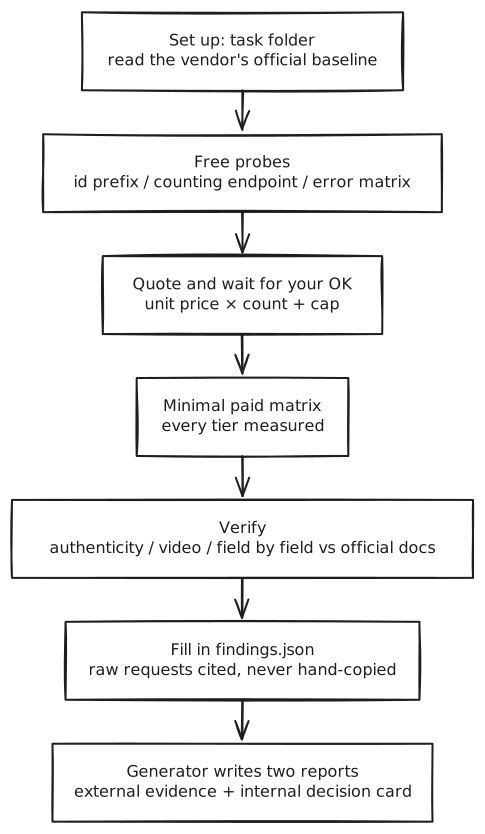
View source (Mermaid)
mermaid7 lines of code
flowchart TB
  A[Set up: task folder<br/>read the vendor's official baseline] --> B[Free probes<br/>id prefix / counting endpoint / error matrix]
  B --> C[Quote and wait for your OK<br/>unit price × count + cap]
  C --> D[Minimal paid matrix<br/>every tier measured]
  D --> E[Verify<br/>authenticity / video / field by field vs official docs]
  E --> F[Fill in findings.json<br/>raw requests cited, never hand-copied]
F --> G[Generator writes two reports<br/>external evidence + internal decision card]Seventeen numbered rules constrain every step the Agent takes, for example: quote before spending (every tier measured, never extrapolated); “identical” must be computed (fields, response headers and streaming event names diffed by a program, not by eye); every raw request goes to JSONL; stop on other people’s data (if a probe exposes another tenant’s data, record only that it is reachable, and read nothing).
It ships official baselines for 10 vendors, plus notes on two kinds of relay programs:
| Line | Official baselines |
|---|---|
| Text | Claude (incl. Bedrock), OpenAI (incl. Azure), Grok, Gemini, Kimi, GLM, DeepSeek |
| Video | Alibaba wan3, MiniMax H3, Seedance (Volcengine Ark / BytePlus) |
| Relay programs | new-api / one-api (groups, ratios, logs, passthrough), sub2api (subscription pools) |
The output
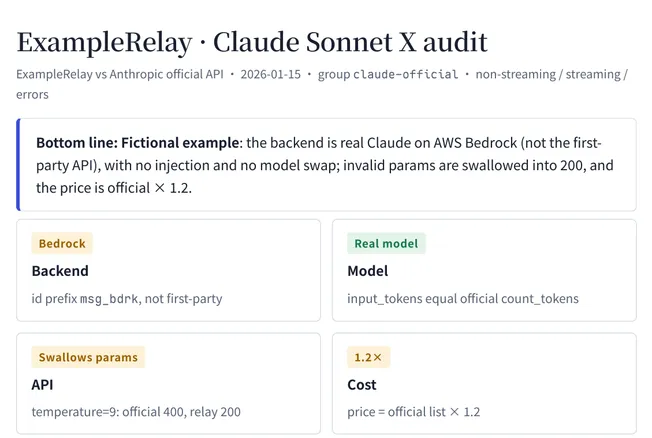
The external evidence report covers only “this relay vs the official API”: claims vs measurements, authenticity evidence, differences ranked by customer impact, what the vendor should fix, and an appendix with official and relay raw requests side by side. Its first page:
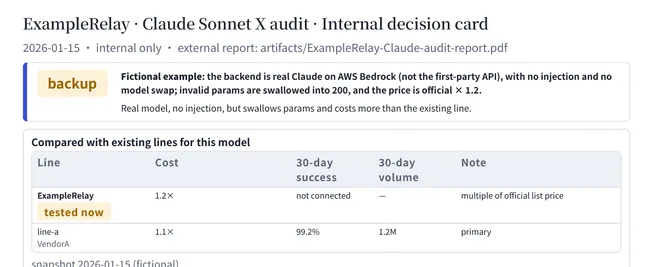
The internal decision card is one A4 page: the verdict (primary / backup / fix first / reject), cost and 30-day success rate against your existing lines for the same model, and what your gateway would need to change:
Write "lang": "en" for an English report; individuals who only want to know whether a relay is genuine can add --external-only to get the external report alone.
Engineering worth mentioning
- Money and keys: the probe library masks keys everywhere it writes (environment, headers, URLs, echoed bodies, raw streams); a paid request that may already have reached the server is never resent, so you never buy one video three times; keys are never sent to a different domain.
- Video authenticity is more than “signature valid”: anyone can self-sign a certificate carrying a vendor’s name, and the signature will still validate. The C2PA check compares the signing certificate’s fingerprint and calls a file official only if it matches an original fetched from the official API.
- No leaks in the external report: the generator refuses to write it if an internal line name, another vendor or anything key-like appears, whether hidden by letter case, escaping, markdown, image captions or file names.
- Verifiable: 84 unit tests; CI runs the tests, example validation, Agent Skills spec validation (
skills-ref), npx discoverability and a secret scan; every GitHub Action is pinned to a commit SHA. - Reviewed three ways before release: before v0.3.0, three independent Agents looked for problems as a new user, a content reviewer and a code auditor; security, billing and content issues were fixed before publishing (details in the CHANGELOG).
Tech stack
Skill · Agent Skills spec (SKILL.md + references + scripts + assets), works with Claude Code, Codex, Cursor and Gemini CLI; also installable from the Claude Code plugin marketplace
Scripts · Python 3.10+ (the report generator and probe library use only the standard library) · headless Chrome for PDFs · c2pa-python · ffmpeg / ffprobe
Engineering · unittest · GitHub Actions · detect-secrets · MIT license
My role
Solo: the audit method (from integration tests of 30-odd relays at work) · rules and procedure design · report generator · sanitizing for open source · testing and release.
Open source; code on GitHub.