Why We Moved from Celery to Temporal for Production Agent Pipelines
In April 2026, we migrated seo-project's task queue from Celery to Temporal. We dropped exactly one dependency (celery), wrote 11 new files (src/infrastructure/temporal/), and renamed our containers from api/worker/beat to api/temporal_worker_blue/green with blue-green deployment.
Contents
- When Celery Works — and When It Doesn’t
- Crack #1: Task State Is Binary — Success or Failure
- Crack #2: Batch Rollback — “One Timeout Sinks All Eight”
- Crack #3: Long-Running Tasks vs. Worker Restarts
- Crack #4: Debugging Without Visibility
- Crack #5: Reliable Scheduling
- Decision Matrix
- When You Don’t Need Temporal
- Architecture Patterns Post-Migration
- Summary
The most common question afterward: why not just keep using Celery? If it’s already running, what’s the point?
This article is the answer. It doesn’t come from documentation comparisons. It comes from production bugs we hit running Agent pipelines at scale.
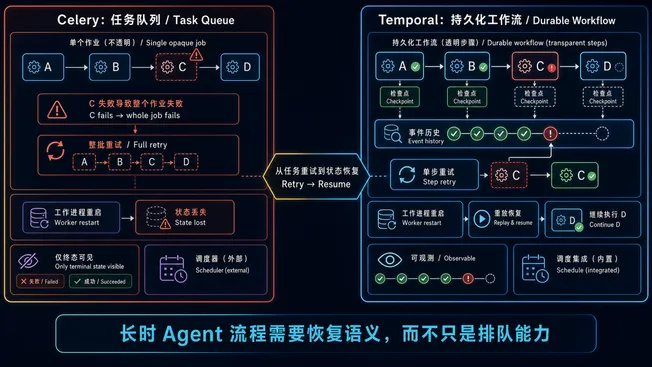
The diagram first separates the problem layers. Celery hands work to workers; Temporal also records event history so a multi-stage workflow can recover from the failure point. The migration was not about replacing a queue with a faster queue. It was about gaining a replayable state machine.
When Celery Works — and When It Doesn’t
Let’s be clear: Celery is a good tool. For standard async workloads — sending an email, resizing an image, pushing a notification — it handles the job perfectly, and has for over a decade.
Our workload, however, looks like this:
text6 lines of code
One Run contains N longtail articles
Each longtail goes through 4 Agent stages: A → B → C → D
Each stage calls one or more AI APIs
Per-article latency: 60–180 seconds
Every intermediate result must be persisted
Any failure must answer: "where did it stop, why, and can I retry only this one step?"This is a stateful, long-running, multi-stage business process. The line between a task queue and a workflow engine runs right through here.
Crack #1: Task State Is Binary — Success or Failure
Celery’s task model: enqueue → worker picks up → execute → success or failure. The entire middle is a black box.
When Agent D times out while generating SEO metadata, Celery tells you: “task failed, state=FAILURE.” What you actually need to know:
- Did Agent A (keyword analysis) complete? What was its output?
- Did Agent B (outline generation) finish?
- Did Agent C (article generation) persist its HTML to the database?
- Which model was Agent D calling when it timed out? Should retry start from D, or from C?
Celery’s answer to all of these: “track it yourself.” You can write state to Redis or a database, but you’re essentially hand-rolling a state machine on top of a task queue — which is exactly what a Temporal workflow provides natively.
In Temporal, your workflow code is the business logic. Every step’s position, return value, and exception is automatically persisted. If the worker restarts, the workflow resumes from the last completed step with zero checkpoint code.
pythonCelery: you manage state yourself21 lines of code
# Celery: you manage state yourself
@app.task(bind=True, max_retries=3)
def run_pipeline(self, longtail_id):
    try:
        result_a = agent_a(longtail_id)        # succeeds
        save_checkpoint("step_a_done", result_a)
        result_b = agent_b(result_a)           # fails here
        # On retry — where do you resume? You figure it out.
    except Exception:
        self.retry()

# Temporal: the workflow *is* the state machine
@workflow.defn
class PipelineWorkflow:
    @workflow.run
    async def run(self, longtail_id: str) -> dict:
        result_a = await workflow.execute_activity(agent_a, longtail_id)
        result_b = await workflow.execute_activity(agent_b, result_a)
        result_c = await workflow.execute_activity(agent_c, result_b)
        result_d = await workflow.execute_activity(agent_d, result_c)
return result_dNo checkpoint management. If agent_c times out, retry picks up from agent_c — the return values of agent_a and agent_b are already persisted in the workflow history.
Crack #2: Batch Rollback — “One Timeout Sinks All Eight”
This was a real production incident.
Our batch pipeline ran N longtails inside a single task loop, each going through A→B→C→D. The database commit sat outside the loop:
pythonAnti-pattern: single transaction for the entire batch5 lines of code
# Anti-pattern: single transaction for the entire batch
async with unit_of_work(autocommit=False) as uow:
    for longtail in batch:
        await run_pipeline(longtail)
await uow.commit() # commit all at onceThen it happened: longtail #3’s Agent C timed out → the SQLAlchemy session went invalid → every subsequent get/save/commit for #4–#8 threw PendingRollbackError → all 8 articles vanished.
The fix was shrinking the transaction boundary to a single longtail: each iteration commits independently, and failed iterations also commit their failure status. With Temporal, this pattern becomes the natural default — each longtail is an independent workflow execution with native idempotency and replayability.
In the Celery model, task failure = entire task rolled back = you control retry granularity by hand. In Temporal, one workflow’s failure doesn’t touch other workflows. Operations sees “1 failed / 7 succeeded” instead of “8 vanished.”
Crack #3: Long-Running Tasks vs. Worker Restarts
Our Agent pipeline runs 60–180 seconds per article. Celery workers restarting (deployments, OOM kills, node recycling) will kill in-flight tasks and re-queue them from scratch.
For sub-5-second tasks, this barely matters. For a task that’s been running 120 seconds, has already burned a hundred thousand tokens, and has one step left — restarting from zero means all that token cost goes up in smoke.
Temporal’s durable execution model works differently: even if the worker dies, workflow state lives in the Temporal Server. A new worker picks up the workflow history and resumes from the last completed activity. This directly impacts AI pipeline cost control.
Crack #4: Debugging Without Visibility
When an Agent pipeline fails in production, here’s the Celery debugging path:
- Find the task ID
- Open Flower (if you installed it) to check task state
- grep through application logs for the trace_id
- Manually reconstruct: “what did A produce → what did B produce → where did C get stuck”
- If there were retries, the picture gets muddier
Here’s the Temporal debugging path:
- Open the Temporal Web UI
- Click into the workflow execution
- Every step’s input, output, duration, and exception is visualized on a single timeline
- You see exactly: “Activity
generate_articlein Agent C timed out at 47 seconds, retried twice — expand to view the prompt and returned HTML for each attempt”
This isn’t “Temporal has a nice UI.” It’s an order-of-magnitude difference in debugging efficiency. For multi-Agent pipelines — long call chains, abundant state, critical intermediate artifacts — visual workflow history is a requirement, not a luxury.
Crack #5: Reliable Scheduling
Celery Beat is a standalone process started with celery beat. Known failure modes:
- Beat goes down → scheduled tasks stop, no failover
- Beat restarts → may double-trigger tasks at the same timestamp
- Scheduling window missed → no automatic backfill, manual intervention required
- Schedule changes → restart required
Our Agent project has a real business requirement: generate a batch of articles per site every day. If the scheduler goes down or misses a window, we need to automatically detect missing dates and backfill.
Celery’s solution is “write a script to compare date gaps, manually dispatch.” Temporal Schedule provides this natively:
- Overlap Policy: what happens when the next trigger fires before the previous workflow finishes
- Catch-up Window: auto-trigger missed executions within a configurable lookback
- Pause/Resume: pause a schedule without editing cron expressions
For content production — where missing a day means you have to catch up — Schedule’s backfill semantics are a hard requirement.
Decision Matrix
| Dimension | Celery | Temporal | Winner for Agent Pipelines |
|---|---|---|---|
| Task model | Stateless task | Stateful workflow | Temporal (Agent pipelines are inherently stateful) |
| State persistence | DIY (Redis/DB) | Automatic workflow history | Temporal (zero extra code) |
| Retry semantics | Task-level, restart from scratch | Activity-level, resume from breakpoint | Temporal (long AI calls have real token cost) |
| Failure visibility | Log grep + Flower | Web UI timeline + per-step I/O | Temporal (order-of-magnitude debugging efficiency) |
| Scheduling | Beat process, no failover | Schedule, built-in catch-up | Temporal (content backfill is a hard requirement) |
| Batch failure radius | Depends on your commit strategy | Each workflow naturally isolated | Temporal (independent idempotent units) |
| Worker restart impact | In-flight tasks lost, restart from zero | Workflow resumes from breakpoint | Temporal (120s AI calls aren’t wasted) |
| Operational complexity | Worker + Beat + Flower + Broker (Redis/RabbitMQ) | Worker + Server (Web UI included) | Comparable (Temporal Server adds deployment cost but removes Flower + Beat overhead) |
| Learning curve | Low (Python-native ecosystem) | Medium (determinism constraints require understanding) | Celery wins for onboarding speed |
| Best for | Short, stateless, low-cost-of-failure tasks | Long-running, stateful, auditable, intermediate-artifact-heavy processes | Depends on workload |
When You Don’t Need Temporal
Celery remains the better choice if:
- Task latency is under 10 seconds; restarting from scratch is negligible
- You don’t need visibility into intermediate step I/O (e.g., sending email)
- You don’t need step-level retry (whole task succeeds or fails)
- Your team has no bandwidth for learning Temporal’s determinism constraints
- Your existing Celery system runs reliably; migration cost > migration benefit
Our decision wasn’t “Temporal is better than Celery.” It was: “the characteristics of Agent pipelines happen to land squarely on Celery’s weak spots and Temporal’s core strengths.”
Architecture Patterns Post-Migration
The migration crystallized several architectural decisions:
1. One longtail = one workflow = one transaction boundary
Batch processing becomes: “dispatch N workflows externally, each workflow manages its own transaction internally.” This is the natural marriage of per-iteration transaction boundaries (from concepts/backend) and Temporal’s execution model.
2. Dual UoW semantics
FastAPI routes use autocommit=True (short request-scoped transactions). Temporal workers use autocommit=False (workflow-scoped, explicit commit/rollback control). Same UoW abstraction, different lifecycle semantics.
3. Blue-green deployment
Containers went from a single worker instance to temporal_worker_blue + temporal_worker_green. Deploy by routing new workflows to the fresh color; drain the old color once in-flight workflows complete. Temporal Task Queue routing makes this zero-downtime.
4. Replay is free
Every workflow execution’s history lives in the Temporal Server. When something breaks, you can replay the entire workflow locally — same inputs, same code path, database calls mocked out — to pinpoint exactly which activity, which invocation, which return value caused the error. In the Celery era, this was hours of manual labor.
Summary
Framing Temporal as “a more powerful Celery” misunderstands both. They solve problems at different layers:
- Celery answers: “run this code on another machine”
- Temporal answers: “guarantee this multi-step business process reaches completion, and make every step auditable”
Agent pipelines happen to be multi-step, long-running, intermediate-artifact-rich business processes with high failure costs. Using a task queue to emulate a workflow engine isn’t using the wrong tool — it’s using the right tool’s predecessor, then hand-building the features the successor already ships.
Based on production experience from seo-project. Migration records in LLM Wiki → log.md (2026-04-10) and concepts/backend.md.